- HOME
- INTRODUCTION
- FEASTS OF GOD
- 1. PASSOVER- Leviticus 23:5
- 2. FEAST OF UNLEAVENED BREAD - Leviticus 23:6-8
- 3. FEAST OF FIRSTFRUITS - Leviticus 23:9-11,14,15
- 4. FEAST OF WEEKS OR PENTECOST - Leviticus 23: 15-16
- 5. FEAST OF TRUMPETS - Leviticus 23:23,25
- 6. ATONEMENT DAY - Leviticus 23: 32,31
- 7. FEAST OF TABERNACLES OR BOOTHS - 23:34-36
- THE WORSHIP ACCEPTABLE TO GOD
- Conclusion
- Italiano
- Francais
FEASTS OF GOD
The project solving all human problems
Chapter:
[ last ]
SCRIPTURE INTERPRETS ITSELF
Scripture Interprets Itself Through Typology
For an exact and progressive understanding of the written revelation, the LORD communicated with man through tangible symbols, defined “types”. And, from these derives the term “typology”[i], the study of Scripture to understand the originals entities prefigured by the biblical types.
Remarkably the Scripture interprets itself through typology. Consequently, all that is needed is studying it, and watching attentively the events of human history, in particular of Israel. These, in fact, enable to discern when a biblical type and a prophetic event is truly and completely fulfilled in its antitype. And, only at that time, it will be once for all. Then, and only then, interpreters of Scripture receive evidence that their interpretation of a symbol, was correct.[iii]
In antiquity the writers of Scripture were very familiar with this divine method of communication. Consequently, they considered real things, real persons, and real events of the past, types of things to come.
Even today, using typology, this symbolic language can be understood without external references by comparing scripture with scripture.
Man’s Redemption in Types and Antitypes
I. The first sacrifice
 The LORD informed progressively about the means He retained necessary to execute the redemption of repented believers, using types.
Firstly, He disclosed the solution to Adam with the promise of a Messiah that would come only from a woman. His Anointed would defeat the “Serpent”, the “Dragon” by suffering and dying innocently to redeem many. Here, the serpent is a tangible type. In fact, it represents the “devil”, “Satan”, the rebellious angel that took possession of the “ancient serpent” to deceive the parents of humanity (Rev. 12:9).
To Adam and Eve, GOD also specified how the extraordinary Seed of the woman would defeat Satan (Gen. 3:15). In fact, after promising a Redeemer, the LORD presented in types the means through which He would fulfill His promise. And He did this by sacrificing an “innocent animal”, most probably a “lamb”. Then, the LORD, out of love, took the skin of the victim and made garments. And, with them, He covered the parents of humanity, left naked and ashamed of their new miserable sinful condition (Gen. 3:21).
Purposely with this first sacrificial death of an innocent victim, GOD taught to Adam that the Seed of Eve will one day die to make them live. And He also dramatically explained that without shedding of blood there is no remission of sin. Ultimately,this sacrifice prefigured the great sacrifice which, in the latter days, should be offered once for all. Thus, the first death in GOD’s Universe was the sacrifice of Christ in a figure.
II. The substitutionary sacrifice
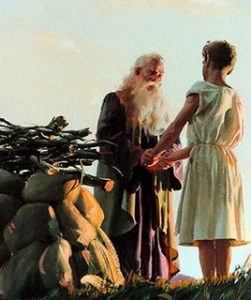 Secondly, the LORD asked Abraham to dramatize the same solution. Trusting in GOD’s promises, our spiritual patriarch offered Isaac, his only legitimate son, as a sacrifice. Yet, as Abraham raised his hands to kill Isaac, the Angel of the LORD stopped him. And, GOD substituted his son with an “innocent victim” He Himself had chosen and provided for the burnt offering (Gen. 22).
This substitutionary sacrifice was a prophetic reenactment. In it, Abraham played the role of our Father who is in Heaven. And, Isaac prefigured GOD’s only Son, sacrificed, once for all, at the fullness of time (John 3:16).
III. The perpetual sacrifice
Thirdly, to the teaching of man’s salvation, GOD added also the spatial dimension through another type, His sanctuary. And, with it He offered other types of the places and means He would use to redeem His believing people. Amazingly, in Scripture the sanctuary typology is used from Genesis to Revelation.
 After liberating Israel, the LORD commanded to build a sanctuary, similar to the one which is in Heaven (Ex. 3:12; 19:11). In obedience, «on the first day of the first month» of the sacred calendar, «the tabernacle was raised up». Then, «the glory of the LORD filled it». Afterwards, «The cloud of the LORD was above the tabernacle by day, fire was over it by night, in the sight of all the house of Israel, throughout all their journey» to the earthly promised land (Ex. 40:17, 35, 38).
In GOD’s sanctuary, the priest offered the perpetual sacrifice, called the “korban tamid” . It was a daily sacrifice of two lambs as burnt offering to maintain a constant relationship with GOD (Exodus 29:38-39). As a matter of fact, one lamb was offered in the morning, and one lamb in the afternoon, each day of the week. In the morning, no sacrifice was before the first lamb. In the afternoon, no sacrifice was after the last lamb. And, they both were holy types, prefiguring the continuous intercession of Christ for the perpetual purification and blessing of repented believers.
The High Priest of GOD
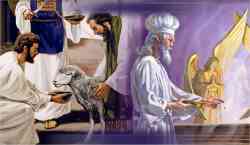 Astonishingly, the sanctuary was a «copy and shadow of the heavenly things» mentioned various times in the book of Revelation (Heb. 8:5).[ii] Indeed, each animal sacrificed on its burnt offering altar was a «shadow of the good things to come» (Heb. 10:1). And, ultimately, it prefigured Jesus Christ, the Savior, the «Lamb of God who takes away the sin of the world» (John 1:29). Who, also, is the «High Priest», the only Mediator between the Father and mankind (John 1:29; Rev. 5:5-6; Heb. 9:6,7, 25).
With the earthly sanctuary and the heavenly sanctuary, the LORD showed how He would accomplish the restoration of His faithful people. Concerning both, «it is what the structures represent, or teach about the great controversy between Christ and Satan, and about the plan of salvation, that matters. The dwelling places of the Deity propose to teach us spiritual truths».[iv]
Without question, what the LORD presents us with His sanctuaries is His good, just and unchangeable will toward fallen man (Ex. 25:22). In fact, He shows in this type the places and wonders through which, at His perfectly fixed dates, He started and will ultimately complete the wonders bringing forth the final rescue of repentant sinners, believing in Him and His Messiah.
Significance of GOD’s Temple
Undoubtedly all that is revealed with the mosaic tabernacle points to the glory of the Father and His saving way with men (Ps. 77:13,19). For this reason, the LORD urged Ezekiel to study it, and to proclaim its message. «Son of man, describe the temple to the house of Israel, that they may be ashamed of their iniquities, and let them measure the pattern. And if they are ashamed of all that they have done, make known to them the design of the temple and its arrangement… its entire design and all its ordinances, and perform them» (Ezek. 43:10,11).
In similar manner, the apostle John, acting the part of true Israel of the last days, was ordered to «rise and measure the temple of God, the altar, and those who worship there» (Rev. 11:1). Indeed, in the penetrating light of GOD’s Good News streaming from the Sanctuary and in its plan, today, the universal people of GOD can be deeply moved through their own sinfulness. And, if they repent, can still find grace, and hear the LORD, from His throne, pronounce the redeeming words, «I will accept you» (Ezek. 43:27, cf. 43:6-27).[vi]
Biblical types testify of Christ
Jesus Christ declared, «You search the Scriptures, for in them you think you have eternal life; and these are they which testify of Me» (John 5:39). Indeed in GOD’s Written Word, many types prefigure the Messiah and His ministry for the redemption of believers.
 It is written, «Your way, O God is in the sanctuary… You are the God who does wonders… You have with your arm redeemed Your people» (Psalm 77:1, 14, 15). Unquestionably, the sanctuary with its rituals presents clearly that it is on earth and through his Lamb, His «only and unique» Son, that our heavenly Father manages the project that will result in the redemption of His people (John 3:16-18). In reality, Jesus came on earth, mysteriously incarnated in a humble human being, to start it. And, He will return, as a glorious King, to complete it.
After His ascension, Jesus is directing the activities leading to man’s redemption from the Heavenly Sanctuary, His actual dwelling place. There, in His tabernacle, the Most Holy Place of GOD, He works on behalf of each repentant believer.[v]
GOD’s redemptive
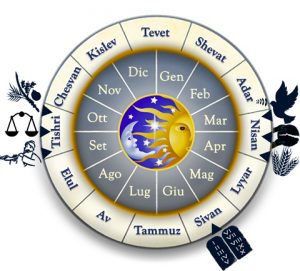 After giving to the teaching of His project for man’s redemption the place and means dimension through His earthly sanctuary, GOD added to it also the time dimension through His weekly Sabbath (Lev. 23:1-3), the seven annual feasts (Lev. 23:4-44), the Septennial and the Jubilee year (Lev. 25).
Especially, the chronology of the annual feasts serves as a divinely ordained calendar. In other words, each feast marks key moments in Israel’s history and represents a specific aspect of GOD’s covenant with His people. And it reveals GOD’s plan for humanity through the progression of the feasts throughout the year.
Concluding, with His appointed times, GOD uses symbolic acts and celebrations that prefigure the redemptive work of His Son, the Messiah. And, all this and more it is revealed through typology, allowing the Scripture to interpret itself.
[i] For further study see website, http://www.theopedia.com/biblical-typology . The Typology of Scripture, (NY and London: Funk & Wagnalls, 1900), I, p. 106; R.T. France, Jesus and the Old Testament (Downers Grove, Ill.: Inter-Varsity Press, 1971), p. 40. Typos, Theological Dictionary of the New Testament. VIII, (Grand Rapids, MI: Eerdmans, 1972), pp. 246-259; Bernard Ramm, Protestant Biblical Interpretation, (Grand Rapids, MI: Baker, 1970), pp. 215-232; Biblical Typology Yesterday and Today, Calvin Theological Journal 5 (1970) pp. 133-162.
[ii] Also Jerusalem is a very dim “shadow” of the city of GOD, (see Heb. 12:22; Rev. 3:12; 2; 22). In fact, the traveling of Abraham toward the earthly promised land and its city, is a type, representing the walk of each individual and family toward GOD’s New Earth and New Jerusalem.
[iii] David H. Stern is a Messianic Jewish theologian. He is the author of the Complete Jewish Bible, a commentary to the New Testament, the Messianic Jewish Manifesto and Restoring the Jewishness of the Gospel, (Clarksville, MD: Jewish New Testament Publications, Inc., first ed. 1984). In the synthesis of this last work titled, Restoring the Jewishness of the Gospel, Section D, Stern mentions four types of Jewish interpretation of Scriptures: the P’shat, Remez, Drash or midrash. These same types are used by the author of this study. For David H. Stern’s publications contact by e-mail: lederer@messianicjewish.net or see website:www.messianicjewish.net.
[iv] Samuele Bacchiocchi, God’s Festivals in Scripture and History, Part II: The Fall Festivals, Biblical Perspectives, (Berrien Springs, MI: 1996), p. 176. Dr. Bacchiocchi is the first non-Catholic to graduate from the Pontifical Gregorian University in Rome. His works include: From Sabbath to Sunday – Sabbath under Crossfire- Immortality or Resurrection? – The Advent Hope for Human Hopelessness – Wine in the Bible, Popular Beliefs – Are they biblical? More information to purchase his publications can be found at: Sbacchiocchi@biblicalperspectives.com; or http://www.biblicalperspectives.com.
[v] Various authors of the Seventh-day Adventist Church, Il Santuario – Il piano di Dio per la Nostra Salvezza, see chapter of Robert S. Folkenberg, “La via degli Altari”, (Falciani, Impruneta, FI: Edizioni ADV, 1996), pp. 18,19.
[vi] For a deeper study on the sanctuary typology see, Wallace B. Nicholson, The Hebrew Sanctuary: a Study in Typology, (Grand Rapids: Baker Book House, 1951. 232.3 n528; Merwin R. Thurber, Symbols of Salvation: How Men are Saved, as Revealed in the Ancient Sanctuary, (Washington D:C:: Review and Herald, 1961, BT 262 .T48; Alfred Felix Vaucher, Le sanctuaire, Collonges-sous-Saleve: Fides, 1970) BT 265 .V37 Heritage; Ellen G. White, Patriarch and Prophets, (Mountain View, CA: Pacific Press, 1958), Chapter 30 “the Tabernacle and Its Services, Chapter 52 – “The annual Feasts”; Christ in the Sanctuary, (Mountain View, CA: Pacific Press, 1969), The Great Controversy between Christ and Satan, (Mountain View, CA: Pacific Press 1950), 488.
Chapter:
[ last ]
THE SACRIFICE BECOMES REALITY WITH CHRIST
 GOD informed beforehand concerning the time when the real Passover sacrifice would become reality with Christ, once and for all. Gabriel said to the prophet Daniel: «Seventy weeks are determined for your people and for your holy city, to finish the transgression, to make an end of sins, to make reconciliation for iniquity, to bring in everlasting righteousness, to seal up vision and prophecy, and to anoint the Most Holy» (Dan. 9:24).
These seventy weeks, according to the prophetic principle one-day=one-year, set by Scripture in Numbers 14:34 and Ezekiel 4:6, are 490 years (70x7days=490 years). The command to restore and build Jerusalem allows to find an approximative date. This is the decree of Artaxerxes, King of Persia, issued in the year 457 B.C.. Indeed, with this alone the people of GOD obtained the permission to restore and build Jerusalem together with its temple. No other. The Scripture that by principle interprets itself, records this decree in Ezra 7:8-26.[i]
The date of Christ’s sacrifice
 Gabriel continued, «Know therefore and understand, that from the going forth of the command to restore and build Jerusalem, until the Messiah the Prince, there shall be seven weeks and sixty-two weeks» (Dan. 9:25-26). The «seven weeks and sixty-two weeks», are sixty-nine weeks of years, prophetically 483 years (69 x 7). If we add to 457 B.C. the 483 years we reach the time Jesus was thirty years old (30).
Gabriel finished his explanation of the seventy-weeks/490-years informing that after the killing of the Messiah, Satan, the prince of demons, by the agency of his human agents, «shall destroy the city and the sanctuary», and profane GOD’s holy things (Dan. 9:26). This is what Satan continues to do, «until the end, which is already determined», will come upon him (Dan. 9:27).
The high priest received the anointing for the priestly ministry in the Sanctuary of GOD at thirty years (See Num. 4:3). So did Jesus Christ, who is the High Priest according to the order of Melchizedek (Ps. 110:4, Heb. 7:17). The Holy Spirit anointed Jesus at His baptism, when He was thirty years old (See Mat. 2:1,16,19; Lk. 1:32). Today, it’s impossible to calculate the exact year when His baptism took place because the calendar has been changed in 1582.[ii]
End of sacrifice and offering
 After His anointment, Jesus accomplished His public ministry by teaching about the new way of salvation (see Mat. 3:13-17; Mark 1:9-11; Luke 3:21-22; John 1:32-34). Then, «in the middle of the week», the seventieth prophetic week (7 years), exactly three and a half years after his baptism (7:2 = 3 ½), He brought «an end to sacrifice and offering» by sacrificing Himself for the redemption of humanity (Dan. 9:27). In fact, He died on wood, as occurred for any animal sacrifice.
The destroyer who «cut off» the Messiah, the Prince of GOD, is Satan (Dan. 9:27). He accomplished this atrocity by manipulating the roman oppressors and the religious leaders of Israel of that time. In fact, they represent the two great categories in which humanity distributed itself since the days of Cain and Abel: the unbeliever and the believer. Satan murdered Christ, not knowing that, manifesting his hate against GOD’s Son, he would have been disclosed. While the Savior would have confirmed, once for all, GOD’s eternal covenant with believing humanity.
GOD’s eternal covenant confirmed once for all
 Jesus replaced the animal “sacrifice” and the burned “offering” taking place in the court of God’s earthly sanctuary with His substitutive-redemptive sacrifice. Therefore, these two alone, ceased to have value for our merciful Father, because these alone were the tangible types prefiguring the sacrifice of His only Son.[iii] Indeed, by suffering and dying, Jesus obtained, on earth and in heaven, once and for all, an eternal righteousness for all faithful believers (See Isa. 53).
The types prefiguring the suffering Messiah and His atoning death were fulfilled in their least details. Jesus Christ gave His life in sacrifice on Passover day. His death occurred on this day for a purpose, to confirm GOD’s eternal covenant, once for all. Jesus knew that His death was to occur on the fourteenth day of Nisan (Aviv) because He knew He would fulfill the Passover sacrifice.
Jesus Christ fulfilled the Passover
 Christ also knew the hour He would suffer and die to redeem His followers. Indeed, He is the true Passover Lamb, the first sacrifice accomplished in the annual cycle of GOD’s feasts. And the true Lamb of GOD, prefigured by the first and the last lamb offering of each single day.
In fact, commanded, «Now this is what you shall offer on the altar: two lambs of the first year, day by day continually. One lamb you shall offer in the morning, and the other lamb you shall offer at twilight … This shall be a continual burnt offering throughout your generations at the door of the tabernacle of meeting before the Lord» (Ex. 29:38-42).
In time, this continual burnt offering became known as the “Tamid Sacrifice“. The Hebrew word “tamid” (תָּמִיד) means “always”, “everlasting”, or “daily offering.” It was the sacrifice of a lamb with the offering of bread and wine. No other sacrifices were to take precedence over it, and no other sacrifices were to follow it.
Jesus Christ is the true Tamid Lamb, the «First and the Last» sacrifice and offering to GOD (Rev. 1:8). As a matter of fact, He, the Lamb of GOD, was crucified in the morning, at the «third hour» of the day, 9 am (Mk 15:25). This is the same exact hour the morning lamb was sacrificed in the temple. And Christ died, at twilight, at the «ninth hour» of the day, 3 pm (Mt. 27:46). This is the exact same hour the evening lamb was offered to end any daily «sacrifice and offering».[iv]
The Lamb of GOD
 Scripture testifies that the first phase of the project solving all human problems started at the miraculous incarnation of the Son of GOD (Luke 1; see Isa. 9:6). And it finished at His sacrificial death. In fact, in the exact day determined before the foundation of the world as His Passover appointment, the Father sacrificed His Son. And wonderfully, He constituted Him Savior of repentant and believing sinners (Dan. 9:24).
The prophet Isaiah (Isa. 53) understood that the suffering Servant of the LORD is Jesus Christ, «the Lamb of God that takes away the sins of the world» (John 1:29).
The apostle John himself saw in heaven Jesus, in the form of «a Lamb as though it had been slain»(Rev. 5:6). And He testified that the Savior has all power, all knowledge and all authority. His «seven horns», «seven eyes», and «seven Spirits of GOD» reveal in fact Jesus’ divinity (Rev. 5:6).
Also Paul, a Jewish doctor of the Law of GOD, describes Christ as «our Passover» (1 Cor. 5:7. For this reason, he encourages believers to keep the feast in remembrance of His redeeming sacrifice (v.8). Our Savior is the «Prince of peace» (Isa. 9:6; 55:4; Mic. 5:1), and the «Prince of life» (Ac. 3:15). Let us therefore proclaim His Name until we will celebrate with Him in GOD’s Kingdom.