- HOME
- INTRODUCTION
- FEASTS OF GOD
- 1. PASSOVER- Leviticus 23:5
- 2. FEAST OF UNLEAVENED BREAD - Leviticus 23:6-8
- 3. FEAST OF FIRSTFRUITS - Leviticus 23:9-11,14,15
- 4. FEAST OF WEEKS OR PENTECOST - Leviticus 23: 15-16
- 5. FEAST OF TRUMPETS - Leviticus 23:23,25
- 6. ATONEMENT DAY - Leviticus 23: 32,31
- 7. FEAST OF TABERNACLES OR BOOTHS - 23:34-36
- THE WORSHIP ACCEPTABLE TO GOD
- Conclusion
- Italiano
- Francais
FEASTS OF GOD
The project solving all human problems
Chapter:
[ Mediator ]
CHRIST IS THE HIGH PRIEST OF GOD
 The Feast of Weeks proclaims that Christ is blessing believers as the High Priest of GOD. In fact, the high priests who served in the sanctuary of GOD were types of Christ, our High Priest. And, they enacted the ministry He is accomplishing in the Tabernacle of Heaven on behalf of any sincere repentant who believes in Him.
Lovingly, since Adam and Eve sinned, the Father Himself designated Christ «to be Prince and Savior, to give repentance to Israel and forgiveness of sins» to all repentant believers (Acts 5:31, 32; Rev. 5:9-12).
Christ our High Priest
At the first Feast of Weeks of the Messianic era, on the fiftieth day after His resurrection, Christ entered the tabernacle of Heaven (Heb. 9:12). And, there He started His ministry as High «Priest of God Most High» (Gen. 14:18).
 Scripture testifies that our Redeemer and Intercessor is not a successor of a human priest, but of Melchizedech, the «King of righteousness» and «King of peace» of the entire universe (Heb. 7:1-3). Therefore, Christ, as Melchizedech, «remains a priest continually», forever (v. 3, 15-17).
Furthermore, Melchizedech did not present to GOD animal sacrifices, but «bread and wine» (Gen 14:18). And, similarly did Jesus at His last Passover Supper in Jerusalem. In fact, on that holy evening, He established that the unleavened bread and unfermented wine would be symbols and reminders of His body and blood offered in sacrifice to GOD for the expiation of sins.
The earthly and heavenly high priest
This chart below shows that in Christ, the High Priest of GOD, the old earthly priesthood met its antitype. And, when Christ was «cut off» on Calvary, the spiritual values of each animal «sacrifice and offering» were made to cease (Dan. 9:27).
| The earthly high priest – the type | Christ, our heavenly High Priest – the antitype |
| Heb. 7:28; 5:1 Earthly priest called among the people. | Heb. 4:14, 15; 2:16-18 Jesus, our High Priest taken from humanity. |
| Heb. 5:4 The priests did not appoint themselves. Ex. 28:1 Aaron was appointed high priest by GOD, and, his sons, as regular priests. Num. 1:47-52; 3 The remaining men of the tribe of Levi were helpers to the priests. | Heb 5:5,6 Christ appointed by the Father.
Rev. 1:5,6 Jesus through the agency of the Spirit appointed His faithful disciples as His witnesses. |
| Lev. 4:27-31; 16:30 The main function of the priest’s service was taking away the guilt of the community by making atonement for them before GOD. | Heb. 9:22; Mat. 26:28 The main purpose of Jesus’ life and death is to expiate sins, save and bless believers. |
| Lev. 1o:16-18; 6:30 The blood or eaten flesh of every animal sin offering was taken into the tabernacle by the high priest. | 1 Pet. 2:24; Isa. 53; Heb 9:24, 28 Christ bore our sins in His own body. |
| Lev. 4:5,6 The blood was presented before the LORD in the sanctuary. | Heb. 9:12 Christ entered the heavenly Tabernacle of GOD Most High with His own blood. |
| Num. 28 and 29, Heb. 9:6 The priest entered daily in the holy place of the tabernacle to perform the services for forgiveness of sins. | Heb. 9:9,11,14 Jesus’ ministry in the first part of the heavenly Tabernacle continues daily throughout the sacred year. |
Christ offered Himself to GOD
 On the Feast of Weeks, the high priest presented two breads to GOD. He commanded, «You shall bring out of your habitations two wave loaves of two-tenths part. They shall be of fine flour; they shall be baked with leaven; they are the firstfruits unto the Lord» (Lev. 23,17).
Even this ritual points to Christ. First it foreshadows Him offering Himself to GOD and interceding for the forgiveness of sins. Jesus Himself spiritually speaking testified to be «the true bread from heaven». In fact, He declared, «Most assuredly, I say to you, Moses did not give you the bread from heaven, but My Father gives you the true bread from heaven» (John 6:32). «For the bread of God is He who comes down from heaven and gives life to the world» (John 6:33).
Secondly, the presentation of the two breads on the Feast of Weeks, or Pentecost, points to the first Jew and Gentile believers that believed in Christ and that He purified, and offered to the Father.
Christ alone is our Mediator
 Christ alone is our Mediator. He alone does not need, day after day, «to offer sacrifices, first for his own sins and then for the people’s, for this He did once for all when He offered Himself» (Heb. 7:26,27). Therefore, people who still depend on human mediators,[i] reject the ministry that Jesus is performing on their behalf in the Tabernacle built by GOD.
Ou explained, «No one comes to the Father except through me» (John 14:6). This means that we only need Jesus Christ for our redemption. No other human being, male or female, dead or alive, on earth or in Heaven, can replace Him. «For there is one God and one Mediator between God and men, the Man Christ Jesus» (1 Tim. 2:5,6).
In conclusion, only Christ can act as our representative before GOD, because only Him has the authority and power to save us, and reconcile us to GOD.
[i] The mediation of Mary is not biblical. This subject is well explained by Samuele Bacchiocchi, Popular Beliefs – Are they Biblical? (Berrien Springs, MI: Biblical Perspectives, 2008), p. 235-237. See book online at http://www.biblicalperspectives.com.
Chapter:
[ Mediator ]
Jesus’ Activity in Heaven
The Feast of Weeks foretells Jesus’ activity in Heaven as our High Priest and Mediator . In fact, after His sacrifice on Golgotha, the Most Holy Place mentioned by the prophet Daniel was anointed (Dan. 9,24). This is no longer the Israelite temple because it ceased to be God’s dwelling place at the moment Christ died. It’s instead the true Tabernacle of GOD in the Heavenly Jerusalem, where Jesus entered after His ascension. There, Christ, the High Priest of the eternal Covenant, inaugurated His work, by an act which corresponded to the anointing of the earthy tabernacle (see Ex. 40, Num. 9:15, 1 Kin. 8:10).
In fact, after His resurrection, our Savior has being continually active on behalf of all His followers. He blesses by «sustaining the church (Rev. 1:13,20), mediating repentance and forgiveness to believers (Acts 5:31; 1 John 2:1,2; 1:9), making our prayers acceptable to God (John 16: 23-24; Rev. 8:3), providing us with the invisible yet real assistance of His angels (Heb. 1:14; Rev. 5:6; 1:16,20), and bestowing upon believers the essential gift of the Holy Spirit (Acts 2:33)».[i]
Christ makes intercession on behalf of repentant believers
 The Feast of Weeks by celebrating the ingathering of the firstfruits of the wheat harvest, portrays Christ daily blessing His followers, the wheat-people.
Indeed, Scripture explains, «Now,…We have a High Priest, who is seated at the right hand of the throne of the Majesty in the heavens, a Minister of the sanctuary and of the true tabernacle which the Lord erected, and not man» (Heb. 8:1-2).
«He, because He continues forever, has an unchangeable priesthood. Therefore He is also able to save to the uttermost those who come to God through Him, since He always lives to make intercession for them» (Heb. 7:24-25).
Christ makes propitiation for the sins of His people
Christ alone has all the power and authority to pardon sins, save, and sustain believers. «For indeed He does not give aid to angels, but He does give aid to the seed of Abraham». He is the only Savior and Mediator we truly have. For this purpose Jesus became a man, «like His brethren, that He might be a merciful and faithful High Priest in things pertaining to God, to make propitiation for the sins of the people. For in that He Himself has suffered, being tempted, He is able to aid those who are tempted» (Heb. 2:16-18).
The activity that Jesus accomplishes in the GOD’s Tabernacle was also prefigured by the function of the daily sacrifice. As a matter of fact, the high priest sacrificed two male lambs of the first year, every day. The first lamb, offered in the morning, initiated the animal sacrifices. The second lamb, offered in the evening, ended all other sacrifice (Num. 28:1-10).
Christ consecrates faithful believers to GOD
 After the sacrifice, the high priest took some of the coals where the lamb was consumed by the fire. And he brought them in the Holy Place, on the altar of perfume to burn before GOD continuously. That perfume always pleased GOD. Therefore He always pardoned all repentant believers living near and far from Jerusalem (Num. 28-29).
The daily sacrifice, the high priest, the ritual of the perfume represented the all sufficient sacrifice of Jesus. It also prefigured Christ as High Priest interceding for His people (Rev. 8:2-4; Dan.12:10; see At 1:5; 2:33; 9:31; Rom. 5:5; 15:13; 16; 1 Pet. 1:2;12). And finally symbolized «the daily consecration of the nation to Jehovah, and their constant dependence upon the atoning blood of Christ».[ii]
Christ gives access to the throne of GOD
 «Within the physical layout of the ancient Israelite camp, the ordinary Israelite worshipper stood several barriers removed from the sanctuary’s innermost sanctum. To gain physical access, it would have been necessary to get by the buffer of priests and Levites and areas surrounding the sacred enclosure. But now, says the author of Hebrews, Christ, our heavenly Priest-Mediator, has opened a door of unlimited access to the heavenly sanctuary itself, the throne room of the living God… »
«Though we do not know the exact form of Jesus’ intercession for us, Scripture offers examples of the idea, albeit from a human standpoint. Two of these occurred in the life of Moses, in connection with the rebellion of Kadesh (Num. 14:10-20), and in connection with the golden calf affair (Ex. 32:9-14, 30-32). These are powerful passages. “But now,” Moses pleads with God in that last reference, “please forgive their sin – but if not, then blot me out of the book you have written” (vs.32, NIV). We also witness such forms of priestly intercession in Daniel (Daniel 9) and in Jesus’ great prayer before His passion (John 17)».[iii]
Plead with Christ to obtain grace
 Jesus’ substitutive, cleansing and sanctifying sacrifice on the cross of Calvary has definitively replaced and abrogated all the sacrifices that the Israelite high priest offered day after day, week after week, and year after year in the court of the earthly sanctuary. Nowadays, as believers repent, Jesus cancels their sins from the records in the heavenly books. In addition, the Spirit assists them with His gifts to be loyal partners of Christ, and royal priests of GOD.
Our Savior cares for us and, on daily basis, assists us in all we need. «For we do not have a High Priest who cannot sympathize with our weaknesses, but was in all points tempted as we are, yet without sin. Let us therefore come boldly to the throne of grace, that we may obtain mercy and find grace to help in time of need» (Heb. 4:15,16).
[i] Samuele Bacchiocchi, Part II: The Fall Festivals, p.165, 166.
[ii] Ellen G.White, Patriarchs and Prophets, p.352.
[iii] Seventh-day Adventist Church, Adult Teachers Sabbath School Bible Study Guide, April-June 2008. The Wonder of Jesus, Principal contributor Roy Adams, (Denmark: Stamborough Press, Ltd.) p. 142. Web site at: http://www.absg.adventist.org
Chapter:
[ Mediator ]
CHRIST EXPIATES HIS PEOPLE’S SINS
Christ will expiate, once for all, the sins of His people on the ultimate Atonement Day of this world history. GOD presented this glorious truth as He prescribed the rituals performed by the high priest in the Most Holy Place of the Sanctuary on this annual Sabbath day.
Christ’s blood alone expiates sins
In the morning of the Day of Atonement, the high priest started his activities by offering to God the blood of a lamb. This was the daily morning sacrifice for the forgiveness of God’s people living near and far from the sanctuary. GOD commanded, one lamb in the morning and one in the twilight each day, to start and end the daily sacrificial schedule. This was to be «a continual burnt offering throughout your generations at the door of the tabernacle of meeting before the Lord» (Ex. 29:38-42).
After, the high priest took a bull, confessed his sins and the sins of his family on its head, and sacrificed it (Lev. 16:3,6).
Then, he washed and clothed himself with holy majestic garments prepared just for ministering in the Most Holy Place of God’s sanctuary (Lev. 16:4). He did this only once a year to present Himself before GOD for receiving the final forgiveness of sins.
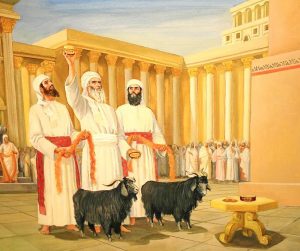 At this time, the people brought to the high priest two goats. And he, in turn, presented them before the door of the tabernacle and casted lots (Lev. 16:7). This way, GOD appointed «one lot for the LORD and the other lot for the scapegoat» (Lev. 16:7-8).
After, the high priest sacrificed the goat of the LORD, for the first time in all the year, without any confession of transgressions on its head.
The blood of the lamb, the bull and the goat for the LORD was a type of Christ’s sacrificial blood. In fact, when Jesus held His last Passover Supper with His disciples, He declared, «This cup is the new covenant in My blood, which is shed for you» (Luke 22:20). And with this statement, He gave an end to the value of each «sacrifice and offering» presented by the Israelite priests (Dan. 9:27).
Christ’s blood atones sins
 Following, the high priest took the goat’s blood, together with the bull’s blood, into the Most Holy Place. Where he could enter only once a year, on the Day of Atonement. And there, he sprinkled it «seven» times «over the mercy seat and in front of the mercy seat» (Lev. 16:15-19). While the place was enveloped by a cloud of incense taken from the altar of perfume.
Then, the high priest returned in the Holy Place. And, with the blood of the bull and of the goat, he sprinkled also «seven» times the altar of perfume (Lev. 16:16). He did this because the record of sins was in the Holy Place, through the lamb’s blood that cleansed them.
In fact, GOD said, that through these procedures, the high priest «shall make an atonement for the holy sanctuary, and he shall make an atonement for the tabernacle of the congregation, and for the altar, and he shall make an atonement for the priests, and for all the people of the congregation» (Lev. 16:33). The LORD commanded this «because of their transgressions» (Lev. 16:16).
Christ alone purifies GOD’s people
In the time of the Temple, the high priest was a type of Christ. And the ministry he accomplished, was also a type of the ministry that Christ accomplishes in the Most Holy Place of Heaven. In reality, the sacrifice of Christ revealed the end of the levitical priesthood, and the empty tomb declared the birth of a new priesthood—one that would never die. For wonderfully, this priesthood came to life when Jesus rose from the grave.
The fact that on the Day of Atonement only the high priest made the final purification, signifies that Christ alone can expiate sins and purify GOD’s people. Scripture provides evidence of this truth. Indeed, concerning the task of the high priest, GOD Himself commanded, «There shall be no man in the tabernacle of meeting when he goes in to make atonement in the Holy Place, until he comes out, that he may make atonement for himself, for his household, and for all the assembly of Israel» (Lev. 16:17).
Christ alone is our Savior. It is He who forgives, cleanses and restore our soul to the origins of humanity. He will soon perform the final and complete purification of repentant people and of the tabernacle of GOD (Lev. 16:17). Let us therefore give ourselves to Him. For He in His atonement gave Himself to save us.
Christ alone is our High Priest
On the Day of Atonement, after the high priest completed the purification in the Most Holy Place and in the Holy Place, he changed his clothes and left them «there» (Lev. 16:23). Then, he came out of the tabernacle of GOD, and back to the people bringing the good news of final absolution.
Similarly, Christ accomplished the expiation of GOD’s people, once for all, by pouring His own blood on the Mercy Seat. After He finished His mission, He rested in the tomb. Then, resurrected, and left His «linen cloths lying there», in the tomb (John 20:5-7). And finally, ascended to Heaven and presented Himself to our eternal Father. Even this is «a powerful testimony to Christ’s priesthood. While the priests of Israel all died, this high priest was raised to life, never to die again. And more, he would now live to intercede for his own (John 17, as their exalted high priest”. [i]
Our High Priest will return
On the Atonement Day, GOD’s people waited outside the Tabernacle until the high priest would come out of it. In repentance and in prayer, they pleaded GOD to express a positive verdict, «from above the mercy seat, from between the cherubim which are on the ark of the Testimony» (Ex. 25:22; Lev. 16:2). And exceeding joy and gratitude filled their hearts as they saw that GOD had answered their prayers.
Soon, Christ, our eternal High Priest, will come out from the Most Holy Place of the Tabernacle in Heaven. When He will finish the final expiation of sins, He will cloth Himself with majestic garments and will return gloriously. Thousands and thousands of angels will be with Him. At His appearing, the trumpets will sound, announcing the beginning of the eternal Jubilee. And, «in a moment, in the twinkling of an eye, ... the dead will be raised imperishable, and we shall be changed. For this perishable body must put on the imperishable, and this mortal body must put on immortality» (1 Cor. 15:52-53).
The end of Satan
 On the Day of Atonement, after the high priest came out of the Tabernacle with the good news of God’s forgiveness, he laid his hands on the head of the second goat, named Azazel. And he confessed on it all sins. Then, he ordered that the animal, symbolizing Satan, be sent to die in the desert (Lev. 16:7-10). That meant, in the land devastated and inhabited by the demons (Mat. 4:1; Luke 8:29; see also Job 38:26; Jer. 33:10).
Through the destiny inflicted to this second goat, GOD predicted the manner in which, at the conclusion of His people’s redemption, He will put on Satan the responsibility of all sins. He will condemn him to destruction, and will take away, once for all, his despotic and evil dominion on earth.
Here in type, the one who introduced iniquity in the government of God receives the right punishment. The responsibility of having induced men and women to rebel against GOD is put on his head. As the scapegoat is brought to die in the desert, at the end of all things, GOD will deliver Satan to the abyss (Rev. 20:1). And finally He will cast him into the lake of fire, where he will find his inexorable destruction.
Christ defends repentant believers
No matter how grievous are the sins, Jesus defends those who sincerely repent and put in Him their hope. For this John affirmed: «My little children, these things I write to you, so that you may not sin. And if anyone sins, we have an Advocate with the Father, Jesus Christ the righteous. And He himself is the propitiation for our sins, and not for ours only but also for the whole world» (1 John 2:1,2).
 The problem lies within us if we think that we do not need to repent because our sins are not serious enough. Indeed, «if we say that we have not sin, we deceive ourselves, and the truth is not in us». Instead, «If we confess our sins, He is faithful and just to forgive us our sins and to cleanse us from all unrighteousness» (1 John 1:8,9).
Again, the Father didn’t send His Messiah to condemn us. However Jesus has to have the proof of a moral behavior motivated by a living faith to save us. In fact, he who «believes in Him is not condemned, but he who does not believe is condemned already, because has not believed in the name of the only begotten Son of God» (John 3:17-18; see also Rom. 1:17).
Active faith pleases GOD
Jesus affirmed: «Whoever confesses Me before men, him I will also confess before My Father who is in heaven» (Mat. 10:32-33). And added: «He who has My commandments and keeps them, it is he who loves Me. And he who loves Me will be loved by Father, and I will love him and manifest Myself to Him» (John 14:21).
These two statements teach that the result of our final evaluation will be absolution or condemnation, on the basis of our trusting and obeying Christ, following His example . Although the greatest «commandments» Jesus gave are two, they are so high, so low, so wide and so narrow in their demands, that we cannot skip a moment of our existence in doing otherwise, if not at risk of our eternal life (Mat. 22:37).
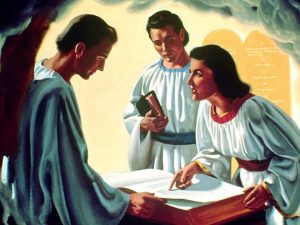
Indeed, Jesus is evaluating how men, women and children express their love for GOD and their neighbor. Our guardian angel writes down our words and works in the book of records (Mal. 3:16; Neh. 13:14; Ps. 56:8). Beside this one and the book with the records of sins, in Heaven, there is also the book of life. The latter contains all the names of those who put their trust in GOD and His beloved Son, Jesus Christ. And of who also follow His commandments (Rev. 20:12; Luke 10:20; Phil. 4:3; Rev. 21:27; 3:5).
Confess your sins to Christ alone
Some Christians still believe that in order to receive spiritual cleansing is necessary to confess the sins to a priest. However Scripture does not make such a statement. In fact, it never reports the confession of sins on the head of an Israelite priest. Jesus alone is the Lamb of God that died to take away sins (Mat. 9:6; Mark 2:10; Luke 5:24). No other man. Therefore, to Him alone sins need to be confessed. For to Him alone has been given the authority to cancel them from our heavenly records.
It is the duty of every believer and religious leader of today to lead people to Christ. He died for expiating their sins, and He is alive for doing it. The persons that neglect to do this, should remember that they, too, will be judged according to their thoughts, words, actions and omissions (Mat. 10:32-33).
Indeed, it is necessary to ask Christ to expiate our sins of omission. This act may seem useless or humiliating for those who do not understand the gravity of omission. Yet, it is exactly the person that trusting in Jesus’ grace, humbles himself before Him, confesses, asks forgiveness and makes efforts to change behavior, who will obtain final cleansing and full redemption.
Religious leaders do not save
Even priests and religious leaders need to go to Jesus in repentance to ask forgiveness (Rom. 3:23). This truth is made evident by the fact that even the Israelite high priest confessed the transgressions he committed on the sacrificial victim. And He confessed to GOD not only his trespasses by also the those of his family. This is something that each father, or head of a household, should do for each member of his family.
This task, regrettably, is not accomplished correctly by various religious leaders. In fact, some of them evaluate the moral cases distressed people bring to them, and then absolve or condemn whom they think best. Not understanding that, in doing so, they are taking the place that is of Jesus by right.
Other religious leaders fear to be rejected if they point out, even privately, the sins their church members are committing. And they do not make an effort to talk with their members about their need of repentance. So, they leave the believers disoriented and confused about their spiritual condition. Until their iniquity ferments like the yeast and explodes in tragedy for the individual and their entire congregation.
Christ invites to go to Him alone
 Furthermore, other religious leaders have assumed the psychologist’s function. And, they believe that this way they can help others to change their minds and practices. Yet, Jesus invited: «Come to me all you who labor and are heavy laden, and I will give you rest» (Mat. 11:28,29,30; see Jos. 1:5; Ps. 30:5; 37:23,24; 84:11; 147:3; Isa. 33:16; 40:31; 49:25; 54:13; Rom. 4:21; 8:28; 1 Cor. 15:57; 2 Pet. 2:9; 3:9).
Consequently, persons who neglect to invite people to confess, repent, forgive, and bringing matters to Jesus, are doing wrong. And people who take in their own hand the moral dilemma of others, are doing wrong, too. Because, practically, they deny the love and power of Jesus to help the sinner and the afflicted. Surely, Jesus will not leave unpunished forever the person that neglects, obscures and puts aside the activity that He accomplishes on behalf of repentant, distressed sinners, in the Holy and Most Holy Place of Heaven.
What please God is faith manifested through genuine love for Him and our fellowmen. It is goodness lived moment by moment in continuous relation with Jesus, the Spirit and the Father. Worshipping GOD in spirit and truth is not a theory of the mind, a philosophy of life, or a weekly good feeling about ourselves and God at church. Neither it is an occasional nice thought and action toward God and our neighbor. It is to think, speak and act like Christ at every breath we take.
Repent!
It is necessary to warn all of the danger of persevering in living a selfish, immoral, arrogant life. Only interceding for them is not enough. Scripture gives evidence of this fact with Moses’ prayer. He interceded for the forgiveness of the rebellious and sinful Israelites. But it was not enough. «The LORD said…: “Whoever has sinned against Me, I will blot him out of My book”» (Ex. 32:33, 31-32). Therefore, until there is time, let us join Jesus and say to all our fellowmen who we know that they are in sin, «repent»! Because Jesus needs to see positive changes in words and actions, to keep their names in the Book of Life (Rev. 3:3,5).
Another condition to be forgiven is to forgive those who have sinned against us (Mat. 6:12; John 20:23; 1 John 1:9). Christ forgave even His enemies. In His agony, He even prayed, «Father, forgive them, for they do not know what they do» (Luke 23:34). Let us follow His example and forgive others all the times. Christ will defend us , bless us, and vindicate our name.
GOD gives a crucial warning on yearly basis with the message of the Atonement Day. He declares, «For any person who is not afflicted in soul on that same day, shall be cut off from among his people» (Lev. 23:29) . That’s why it is so important to keep this annual Sabbath with a humble attitude, for introspection, repentance and supplication for the eradication of sin from our life.
[i] David Schrock, The Clothes Make the Man: Seeing the Priesthood of Christ in John’s Gospel, April 2023; https://christoverall.com/article/concise/the-clothes-make-the-man-seeing-the-priesthood-of-christ-in-johns-gospel/#:~:text=And%20for%20all%20those%20who,mediator%20of%20a%20new%20covenant.