- HOME
- INTRODUCTION
- FEASTS OF GOD
- 1. PASSOVER- Leviticus 23:5
- 2. FEAST OF UNLEAVENED BREAD - Leviticus 23:6-8
- 3. FEAST OF FIRSTFRUITS - Leviticus 23:9-11,14,15
- 4. FEAST OF WEEKS OR PENTECOST - Leviticus 23: 15-16
- 5. FEAST OF TRUMPETS - Leviticus 23:23,25
- 6. ATONEMENT DAY - Leviticus 23: 32,31
- 7. FEAST OF TABERNACLES OR BOOTHS - 23:34-36
- THE WORSHIP ACCEPTABLE TO GOD
- Conclusion
- Italiano
- Francais
FEASTS OF GOD
The project solving all human problems
Chapter:
[ Scripture ]
WORSHIP GOD IN SPIRIT AND TRUTH
«True worshippers will worship the Father in spirit and truth, for the Father is seeking such to worship Him.
God is Spirit, and those who worship Him must worship in spirit and truth»
(John 4:23,24).
 The Holy Bible provides all the fundamental standards for the worship acceptable to GOD. Yet, in our society today, many believers worship GOD following the practices of religious leaders that do not preach and live all the truth. Because of this, some of them think that they can please GOD, through the mediation of persons dead or alive. Others pray, attend spiritual meetings and worship GOD very sporadicly.
There are also people who suppose that once baptized, forgiven, and sealed for salvation through baptism, they remain always saved. But that’s a lie, a deception. In fact, «the LORD said unto Moses, “Whosoever has sinned against me, him will I blot out of my book“» Ex. 32:33). This implies that there is no salvation for any worshipper of GOD who keeps consciously transgressing His commandments.
GOD is good just and holy
Our Father who is in Heaven is perfect, good, just and holy. Yet, many believers think that He is so good that, finally, He will save all people, in spite of what they believe, say, and do. For them worshipping GOD means singing a few loud songs and praying when they feel the need of help. Others think that giving offerings and tithes to their churches and doing some good, is all that GOD requires.
 Yet, Jesus Himself encourages to resist the temptation to follow human traditions contrary to GOD’s commandments. He warns, «He that overcomes, the same shall be clothed in white raiment; and I will not blot out his name out of the book of life, but I will confess his name before my Father, and before his angels» (Rev. 3:5). Therefore, we better make all efforts to walk with GOD, and not with transgressors of His commandments.
Worship GOD in spirit and truth
 Even in this generation there are believers who acknowledge that the Sabbath of GOD’s Law is not Sunday (Day of the Sun). But they fear to lose their jobs or to become victim of persecution if they keep the LORD’s Sabbaths. Consequently, they have resolved to worship GOD on Sunday, and to consider His Sabbaths and seven annual feasts obsolete. Nevertheless, nowhere it is written that Jesus Christ, will ignore their refusal to put into practice GOD’s commandments as prescribed. Instead, He warns that «whoever loves and practice a lie» will be left out of the New Kingdom of GOD (Rev. 22:15,14; see Ps. 5:6; Pr. 6:19; 19:5).
We have to clean up our worship from all lies of human invention, if we truly want to please GOD. «God is Spirit, and those who worship Him must worship in spirit and truth» (John 4:23,24). This is the worship acceptable to GOD. To reach excellence in our relationship with the Almighty, we need to obey His commandments. In addition, we are called to respect the Sabbaths and feasts of the LORD as prescribed in Scripture (Lev. 23). And we urgently need to abandon all unbiblical practices, all oversleeping, all overeating and all over-indulging.
 It is important that we relate to GOD like to a perfect, just, good Father. Now is the time to know Him, love Him and learn to please Him. Tomorrow it could be too late. From now, let us also respect all His appointed times, His Sabbaths, the weekly and the yearly ones. So that we may bring glory, honor and joy to our Him and to Christ, who is fulfilling their message. These are the holy times to meet with Him and worship Him in spirit, truth and love.
Therefore, commit yourself to sanctify all His appointed Sabbaths. Praise GOD for who He is, He was and He will be. And never cease to thank Him for what He has done, is doing, and will do. Love, Him, trust Him and obey Him. Since this is the way to offer Him, and His beloved Son, an acceptable worship.
 Considering the questions previously stated, the purpose of this study is to search in-depth Scripture, and reveal the message of GOD’s seven annual feasts. It also attempts to shortly indicate how to worship GOD during their Sabbaths.
 This is a search on the Scripture alone, and, more precisely, on Leviticus 23. Therefore, also the indications for the observance of the annual feasts derive exclusively from Scripture. In fact, it alone can guide to understand their message and correct celebration, to teach their truth and spread of the Good News of salvation, to know GOD and worship Him.
 Secondly, all true believers in Scripture need to harmonize their faith and practice to the «commandments of God». And, they should relate to GOD following the example and the «testimony of Jesus Christ» (Rev. 12:17; 14:12; 19:10). Only these enable believers to know and love our Father who is in heaven, and prepare for His New Kingdom. Beyond these, there is no assurance of living according to divine truth, and of worshipping GOD in spirit and truth.
 We human beings have a limited memory. For this reason, the LORD established seven annual feasts, proclaiming specific messages. «These are My feasts», declares the LORD Himself (Lev. 23:1). Furthermore, Moses reports, «These are the feasts of the LORD, holy convocations which you shall proclaim at their appointed times» (Lev. 23:2).
Chapter:
[ Scripture ]
SCRIPTURE INTERPRETS ITSELF
Scripture Interprets Itself Through Typology
For an exact and progressive understanding of the written revelation, the LORD communicated with man through tangible symbols, defined “types”. And, from these derives the term “typology”[i], the study of Scripture to understand the originals entities prefigured by the biblical types.
Remarkably the Scripture interprets itself through typology. Consequently, all that is needed is studying it, and watching attentively the events of human history, in particular of Israel. These, in fact, enable to discern when a biblical type and a prophetic event is truly and completely fulfilled in its antitype. And, only at that time, it will be once for all. Then, and only then, interpreters of Scripture receive evidence that their interpretation of a symbol, was correct.[iii]
In antiquity the writers of Scripture were very familiar with this divine method of communication. Consequently, they considered real things, real persons, and real events of the past, types of things to come.
Even today, using typology, this symbolic language can be understood without external references by comparing scripture with scripture.
Man’s Redemption in Types and Antitypes
I. The first sacrifice
 The LORD informed progressively about the means He retained necessary to execute the redemption of repented believers, using types.
Firstly, He disclosed the solution to Adam with the promise of a Messiah that would come only from a woman. His Anointed would defeat the “Serpent”, the “Dragon” by suffering and dying innocently to redeem many. Here, the serpent is a tangible type. In fact, it represents the “devil”, “Satan”, the rebellious angel that took possession of the “ancient serpent” to deceive the parents of humanity (Rev. 12:9).
To Adam and Eve, GOD also specified how the extraordinary Seed of the woman would defeat Satan (Gen. 3:15). In fact, after promising a Redeemer, the LORD presented in types the means through which He would fulfill His promise. And He did this by sacrificing an “innocent animal”, most probably a “lamb”. Then, the LORD, out of love, took the skin of the victim and made garments. And, with them, He covered the parents of humanity, left naked and ashamed of their new miserable sinful condition (Gen. 3:21).
Purposely with this first sacrificial death of an innocent victim, GOD taught to Adam that the Seed of Eve will one day die to make them live. And He also dramatically explained that without shedding of blood there is no remission of sin. Ultimately,this sacrifice prefigured the great sacrifice which, in the latter days, should be offered once for all. Thus, the first death in GOD’s Universe was the sacrifice of Christ in a figure.
II. The substitutionary sacrifice
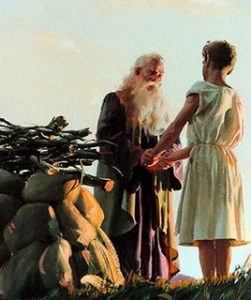 Secondly, the LORD asked Abraham to dramatize the same solution. Trusting in GOD’s promises, our spiritual patriarch offered Isaac, his only legitimate son, as a sacrifice. Yet, as Abraham raised his hands to kill Isaac, the Angel of the LORD stopped him. And, GOD substituted his son with an “innocent victim” He Himself had chosen and provided for the burnt offering (Gen. 22).
This substitutionary sacrifice was a prophetic reenactment. In it, Abraham played the role of our Father who is in Heaven. And, Isaac prefigured GOD’s only Son, sacrificed, once for all, at the fullness of time (John 3:16).
III. The perpetual sacrifice
Thirdly, to the teaching of man’s salvation, GOD added also the spatial dimension through another type, His sanctuary. And, with it He offered other types of the places and means He would use to redeem His believing people. Amazingly, in Scripture the sanctuary typology is used from Genesis to Revelation.
 After liberating Israel, the LORD commanded to build a sanctuary, similar to the one which is in Heaven (Ex. 3:12; 19:11). In obedience, «on the first day of the first month» of the sacred calendar, «the tabernacle was raised up». Then, «the glory of the LORD filled it». Afterwards, «The cloud of the LORD was above the tabernacle by day, fire was over it by night, in the sight of all the house of Israel, throughout all their journey» to the earthly promised land (Ex. 40:17, 35, 38).
In GOD’s sanctuary, the priest offered the perpetual sacrifice, called the “korban tamid” . It was a daily sacrifice of two lambs as burnt offering to maintain a constant relationship with GOD (Exodus 29:38-39). As a matter of fact, one lamb was offered in the morning, and one lamb in the afternoon, each day of the week. In the morning, no sacrifice was before the first lamb. In the afternoon, no sacrifice was after the last lamb. And, they both were holy types, prefiguring the continuous intercession of Christ for the perpetual purification and blessing of repented believers.
The High Priest of GOD
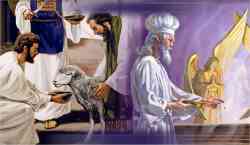 Astonishingly, the sanctuary was a «copy and shadow of the heavenly things» mentioned various times in the book of Revelation (Heb. 8:5).[ii] Indeed, each animal sacrificed on its burnt offering altar was a «shadow of the good things to come» (Heb. 10:1). And, ultimately, it prefigured Jesus Christ, the Savior, the «Lamb of God who takes away the sin of the world» (John 1:29). Who, also, is the «High Priest», the only Mediator between the Father and mankind (John 1:29; Rev. 5:5-6; Heb. 9:6,7, 25).
With the earthly sanctuary and the heavenly sanctuary, the LORD showed how He would accomplish the restoration of His faithful people. Concerning both, «it is what the structures represent, or teach about the great controversy between Christ and Satan, and about the plan of salvation, that matters. The dwelling places of the Deity propose to teach us spiritual truths».[iv]
Without question, what the LORD presents us with His sanctuaries is His good, just and unchangeable will toward fallen man (Ex. 25:22). In fact, He shows in this type the places and wonders through which, at His perfectly fixed dates, He started and will ultimately complete the wonders bringing forth the final rescue of repentant sinners, believing in Him and His Messiah.
Significance of GOD’s Temple
Undoubtedly all that is revealed with the mosaic tabernacle points to the glory of the Father and His saving way with men (Ps. 77:13,19). For this reason, the LORD urged Ezekiel to study it, and to proclaim its message. «Son of man, describe the temple to the house of Israel, that they may be ashamed of their iniquities, and let them measure the pattern. And if they are ashamed of all that they have done, make known to them the design of the temple and its arrangement… its entire design and all its ordinances, and perform them» (Ezek. 43:10,11).
In similar manner, the apostle John, acting the part of true Israel of the last days, was ordered to «rise and measure the temple of God, the altar, and those who worship there» (Rev. 11:1). Indeed, in the penetrating light of GOD’s Good News streaming from the Sanctuary and in its plan, today, the universal people of GOD can be deeply moved through their own sinfulness. And, if they repent, can still find grace, and hear the LORD, from His throne, pronounce the redeeming words, «I will accept you» (Ezek. 43:27, cf. 43:6-27).[vi]
Biblical types testify of Christ
Jesus Christ declared, «You search the Scriptures, for in them you think you have eternal life; and these are they which testify of Me» (John 5:39). Indeed in GOD’s Written Word, many types prefigure the Messiah and His ministry for the redemption of believers.
 It is written, «Your way, O God is in the sanctuary… You are the God who does wonders… You have with your arm redeemed Your people» (Psalm 77:1, 14, 15). Unquestionably, the sanctuary with its rituals presents clearly that it is on earth and through his Lamb, His «only and unique» Son, that our heavenly Father manages the project that will result in the redemption of His people (John 3:16-18). In reality, Jesus came on earth, mysteriously incarnated in a humble human being, to start it. And, He will return, as a glorious King, to complete it.
After His ascension, Jesus is directing the activities leading to man’s redemption from the Heavenly Sanctuary, His actual dwelling place. There, in His tabernacle, the Most Holy Place of GOD, He works on behalf of each repentant believer.[v]
GOD’s redemptive
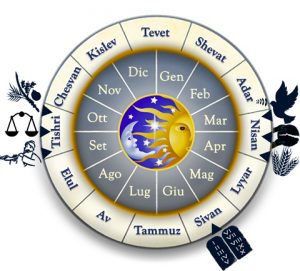 After giving to the teaching of His project for man’s redemption the place and means dimension through His earthly sanctuary, GOD added to it also the time dimension through His weekly Sabbath (Lev. 23:1-3), the seven annual feasts (Lev. 23:4-44), the Septennial and the Jubilee year (Lev. 25).
Especially, the chronology of the annual feasts serves as a divinely ordained calendar. In other words, each feast marks key moments in Israel’s history and represents a specific aspect of GOD’s covenant with His people. And it reveals GOD’s plan for humanity through the progression of the feasts throughout the year.
Concluding, with His appointed times, GOD uses symbolic acts and celebrations that prefigure the redemptive work of His Son, the Messiah. And, all this and more it is revealed through typology, allowing the Scripture to interpret itself.
[i] For further study see website, http://www.theopedia.com/biblical-typology . The Typology of Scripture, (NY and London: Funk & Wagnalls, 1900), I, p. 106; R.T. France, Jesus and the Old Testament (Downers Grove, Ill.: Inter-Varsity Press, 1971), p. 40. Typos, Theological Dictionary of the New Testament. VIII, (Grand Rapids, MI: Eerdmans, 1972), pp. 246-259; Bernard Ramm, Protestant Biblical Interpretation, (Grand Rapids, MI: Baker, 1970), pp. 215-232; Biblical Typology Yesterday and Today, Calvin Theological Journal 5 (1970) pp. 133-162.
[ii] Also Jerusalem is a very dim “shadow” of the city of GOD, (see Heb. 12:22; Rev. 3:12; 2; 22). In fact, the traveling of Abraham toward the earthly promised land and its city, is a type, representing the walk of each individual and family toward GOD’s New Earth and New Jerusalem.
[iii] David H. Stern is a Messianic Jewish theologian. He is the author of the Complete Jewish Bible, a commentary to the New Testament, the Messianic Jewish Manifesto and Restoring the Jewishness of the Gospel, (Clarksville, MD: Jewish New Testament Publications, Inc., first ed. 1984). In the synthesis of this last work titled, Restoring the Jewishness of the Gospel, Section D, Stern mentions four types of Jewish interpretation of Scriptures: the P’shat, Remez, Drash or midrash. These same types are used by the author of this study. For David H. Stern’s publications contact by e-mail: lederer@messianicjewish.net or see website:www.messianicjewish.net.
[iv] Samuele Bacchiocchi, God’s Festivals in Scripture and History, Part II: The Fall Festivals, Biblical Perspectives, (Berrien Springs, MI: 1996), p. 176. Dr. Bacchiocchi is the first non-Catholic to graduate from the Pontifical Gregorian University in Rome. His works include: From Sabbath to Sunday – Sabbath under Crossfire- Immortality or Resurrection? – The Advent Hope for Human Hopelessness – Wine in the Bible, Popular Beliefs – Are they biblical? More information to purchase his publications can be found at: Sbacchiocchi@biblicalperspectives.com; or http://www.biblicalperspectives.com.
[v] Various authors of the Seventh-day Adventist Church, Il Santuario – Il piano di Dio per la Nostra Salvezza, see chapter of Robert S. Folkenberg, “La via degli Altari”, (Falciani, Impruneta, FI: Edizioni ADV, 1996), pp. 18,19.
[vi] For a deeper study on the sanctuary typology see, Wallace B. Nicholson, The Hebrew Sanctuary: a Study in Typology, (Grand Rapids: Baker Book House, 1951. 232.3 n528; Merwin R. Thurber, Symbols of Salvation: How Men are Saved, as Revealed in the Ancient Sanctuary, (Washington D:C:: Review and Herald, 1961, BT 262 .T48; Alfred Felix Vaucher, Le sanctuaire, Collonges-sous-Saleve: Fides, 1970) BT 265 .V37 Heritage; Ellen G. White, Patriarch and Prophets, (Mountain View, CA: Pacific Press, 1958), Chapter 30 “the Tabernacle and Its Services, Chapter 52 – “The annual Feasts”; Christ in the Sanctuary, (Mountain View, CA: Pacific Press, 1969), The Great Controversy between Christ and Satan, (Mountain View, CA: Pacific Press 1950), 488.
Chapter:
[ Scripture ]
The step that introduces a new life
 Christ in His preaching pointed at the baptism by immersion as the step that introduces believers to a new life. Jesus taught that knowledge of Scripture and faith alone, are not enough to live pleasing GOD. Actions demonstrate a living faith. And the first step of faith is to sign an eternal agreement with Him through a conscious baptism by immersion. Furthermore, Jesus’ baptism at the age of twenty-seven or thirty, shows that it is a conscious, personal decision. And this signifies that He requires a baptism by immersion at a mature age.
 The Scripture assists in understanding the spiritual event that takes place at baptism. In fact, it compares the new life of the believer starting at baptism to the birth of a baby. It declares, «whoever believes that Jesus is the Christ is born of God… This is He who came by water and by blood – Jesus Christ, not only by water, but by water and blood. And it is the Spirit who bears witness, because the Spirit is truth. For there are three who bear witness in heaven, the Father, the Word, and the Holy Spirit, and these three are one» (1 John 5:1,6-8).
A new spiritual life
Today, there are mature people professing to believe in Christ, yet not willing to follow His teachings and commands. And taking Scripture lightly, they do not commit themselves to follow His example of baptism. Nevertheless, rejecting to accomplish this official and public demonstrations of faith, they neglect to fulfill the prerequisites necessary to please GOD. And they do not allow Christ to forgive, purify and prepare them for His new kingdom.
Notice that Christ did not need a baptism of repentance. Yet, when John the Baptist, hesitated to baptize Him, He «said to him, “Permit it to be so now, for thus it is fitting for us to fulfill all righteousness”» (Mat. 3:15). It is therefore fitting also for every believer to start a righteous life with a baptism by immersion.
Baptism and Redemption
 «He who believes and is baptized will be saved» stated Jesus (Mark 16:16). Therefore, skipping the first step that introduces to a new spiritual life, thinking that things will be all right anyway, is a pure illusion. Who believes in Christ, acts according to His examples, His commands, and puts Him first of all. And who does not put also Christ first, in reality does not want Him as Savior, either. Consequently, the refusal to obey, prevents the Savior from cleansing them as He wishes to do.
Jesus was baptized by immersion in adult age before GOD, men and all the intelligent beings of the universe. Therefore, when the Holy Spirit, having convinced about Jesus and our sinfulness, prompts to sign an eternal agreement with GOD for our redemption, let us take His example seriously, and be baptized (Col. 3:1-3).[i]
[i] For deeper presentation on baptism see: Samuele Bacchiocchi, Popular Beliefs – Are they Biblical? chapter 10. Infant Baptism (Berrien Springs, MI: Biblical Perspectives, 2008), 379.348-379.
Chapter:
[ Scripture ]
2. FEAST OF UNLEAVENED BREAD
«On the fifteen day of the same month is the Feast of Unleavened Bread to the LORD; for seven days you must eat unleavened bread. On the first day you shall have a holy convocation; you shall do not customary work on it» (Lev. 23:6-8).

The Feast of Unleavened Bread (חג המצות) follows immediately Passover. Its institution is recorded in Exodus 12:1-3, Leviticus 23:5-8; Numbers 28:17-25; Deuteronomy 16:3-4,8.
Its celebration starts on the 15th of Nisan (Abib), at the sunset of the 14th, and last seven days. The first and seventh day are Sabbaths, days of worship, and absolute rest from any lucrative activity.
As the name indicates, GOD’s people abstained from eating leaven (yeast) during this feast. In addition, they also removed any kind of fermented food from their homes (Ex. 12:19).
For this feast, the LORD required that the males of His people go to Jerusalem to meet in His presence. At the temple of GOD they joyfully brought thanksgiving gifts for His overabundant provisions (Deut. 16:16; Lev. 23:8). While, to the Levites the LORD ordered an offering by fire for each of its seven days (Lev. 23:8).
In a particular way, the unleavened bread of this feast commemorates the manna that GOD provided directly from heaven to feed His people. In fact, Scripture reports that during the entire forty-years journey in the desert, Israel received daily this wholesome food (Ex. 16:31, 16:35; Deut. 8:3; Josh. 5:12; Num. 9:20).
After the remanent of Israel entered in the land promised, «the LORD said to Joshua, “This day I have rolled away the reproach of Egypt from you.”…Now the children of Israel camped in Gilgal, and kept the Passover on the fourteenth day of the month at twilight on the plains of Jericho. And they ate the produce of the land; and the children no longer had manna, but they had the food of the land of Canaan that year» (Josh 5:9-12).

Centuries later, another remanent of the people of God returned to their promised land after the exile in Babylon. And again, they started their religious celebrations with the Passover and the Feast of Unleavened Bread. Filled with gratitude, Ezra reports, «the descendants of the captivity kept the Passover on the fourteenth day of the first month… ate together… And they kept the Feast of Unleavened Bread seven days with joy, for the LORD made them joyful» (Ezra 6:19-22). Even today, because of GOD’s redemption and blessings, we are called to celebrate this feast with thanksgiving, gratitude, and joy.
Chapter:
[ Scripture ]
BELIEVERS AVOID SIN

The seven day Feast of Unleavened Bread reminds believers to avoid sin, and be winners with Christ over every temptation. The Savior who has not sinned, desires that His followers be nourished by His love, justice and truth. Therefore, let us pray and ask constantly for His blessings. He is the One that can enable us to be holy, and winners with Him over every temptation.
«Purge out the old leaven»
The transgression of GOD’s Law has a destructive power upon man. For this reason Jesus exhorts repeatedly His followers to get rid of its curse (Mat. 16:16-12; Mark 8:15)[i]. Believers need to avoid sin, and make efforts to purge out their life from the «leaven» of the Pharisees of ancient time. It represents wickedness, false doctrines, avidity, false religious zeal, distortion of the true spiritual values, omission of justice and love (Mat. 23:14-36). They have also to remove the «leaven» of the Sadducees who lived at Jesus’ time. It symbolizes skepticism, intolerance, cruelty, lack of appreciation of the inspired Scripture and of the power of GOD (Mat. 22:23-29).
Paul wrote about the urgency of abandoning «leaven» such as incredulity, pride and selfishness. He explained to the Corinthians, «Your glorifying is not good. Do you not know that a little leaven leavens the whole lump? Therefore purge out the old leaven, that you may be a new lump, since you truly are unleavened. For indeed Christ, our Passover, was sacrificed for us. Therefore let us keep the feast, not with the leaven of malice and wickedness, but with the unleavened bread of sincerity and truth» (1 Cor. 5:6-8).
How to avoid sin
As it has been evidenced the Feast of Unleavened Bread reminds that GOD sent down from heaven the manna. For forty years, during the entire journey of Israel to the promised land, He provided this nutritious unleavened bread (Ex. 16:35). In the same way, today, every believer needs to feed from GOD’s Law and the testimony of Jesus on daily basis. To ro please the LORD it is necessary to interiorize Scripture, its instructions and promises. This is the provision and the way to be spiritually strong and overcome all the challenges of our journey.
In fact, «… while Passover is the type of Christ’s death Godward, the seven day feast of the unleavened bread, points to the whole course and character of the believer’s life on earth, from the day of conversion onward».[ii] Let us «Repent, therefore» and consecrate our heart, mind and soul to follow Jesus’ example and avoid sin. He can purify us and the Spirit can guide and sustain us with His empowering gifts, to be victorious. Indeed, «He who has an ear, let him hear what the Spirit says to the churches. To him who overcomes I will give some of the hidden manna to eat», promises our Redeemer (Rev. 2:16-17).
[i] Yeast is presented as the agent that makes the kingdom of God grow only in the sanctuary and in Mat. 13:33.
[ii] Ritchie, p. 29.
Chapter:
[ Scripture ]
The evidence of the Spirit’s final activity
 On the Feast of Weeks that followed Jesus’ resurrection, the Holy Spirit sealed on their forehead the first human harvest of Christ. Soon His ministry will end. The separation of the last “wheat-people” from the “tare-people” is almost complete worldwide. And surely, this is the evidence of the Spirit’s final activity.
Believers and unbelievers reaching maturity
All humanity is getting closer and closer to complete maturity, as in one parable that Jesus told (Mat. 13:24-43) . On one side, true believers in Christ are reaching spiritual maturity by nurturing their faith and obeying GOD’s commandments. We see them teaching the Law of GOD and preaching the testimony of Jesus. They translated the Scripture in the languages of every nation and ethnic group. We witness “wheat-people”, Jews and Gentiles, converting to Christ, and preparing for His return in every continent of the earth. These are the spiritual fruits produced by the believers in Christ, empowered by the Holy Spirit. These are the “wheat-people” that will inherit the New Earth.
On the opposite side, the unbelievers are reaching maturity by rejecting GOD  and Christ, and practicing what grieves the Holy Spirit. In fact, we see “tare-people” busy as never before, destroying the earth and the most vulnerable of humanity. Sooner than we expect, the great Reaper of the Father will come back. And He will gather, first, the bundles of “wheat-people” for GOD’s «Kingdom». And then, He finally will exterminate the bundles of the irreverent, blasphemous, idolater, wicked, corrupt “tare-people” burning them with «fire» (Mat. 13:35-43).
Preparing the harvest
 In these last days before Jesus’ return, all believers need to collaborate more effectively with the Hoy Spirit. Let us unite in «spirit and truth» to spread the Good News of salvation in Christ. And contribute with all our human resources so that Jesus’ information agency on earth may achieve its mission. With our efforts, the over powerful gifts of the Spirit, and the partnership of Christ’s angels, we will surely succeed in our corporative endeavor to prepare a people ready to welcome our wonderful Savior. There is no doubt about our success, because on our side there are all the resources of our almighty GOD. Therefore, let us not make it happen again that Jesus has to say, «the harvest truly is plentiful, but the laborers are few… pray the Lord of the harvest to send out laborers into His harvest» (Mat. 9:37-38; Luke 10:2)
Chapter:
[ Scripture ]
GOD’S BLESSINGS BECOME ETERNAL
The Feast of Weeks proclaims that all GOD’s blessings and promises will, one day, become an eternal reality. Jesus will soon return to gather His wheat-people and accomplish the reunion of those who have believed in Him. In that glorious day, He will also grant them the gift of eternal life, and bless them beyond their hopes.
Scripture reports that on the Feast of Weeks that followed Christ’s resurrection, the LORD sent the Holy Spirit. And with Him, a shower of spiritual blessings that led many people to Christ (Acts 2). GOD has promised that will grant even greater blessings before the ultimate harvest of believing souls.
It’s important to know that Feast of Weeks concludes the” last rain” period in Israel, which is from March to May. When GOD supplies the fields with abundance of rain the wheat harvest is also abundant. It is exactly at this same time of the year that the Holy Spirit bestowed an abundant shower of gifts upon believers in Christ. So, they preached with enthusiasm about the Savior. And, miraculously, on that blessed Feast of Weeks, «there were added unto them about three thousand souls» (Acts 2:41).
The last rain of spiritual gifts
 On a future Feast of Weeks, the powerful gifts of the Spirit of GOD will be multiplied seven times seven. And, in the heart of the believers the love for Christ will increase seventy times seven. As a result, their love for perishing souls will become as great as the one that they have for themselves. So, they will preach and teach the Word of GOD with conviction and persuasion. And a great number of Jews and Gentiles will repent, turn to GOD and Christ, and receive salvation.
Therefore, «Let us now fear the LORD our God, who gives rain, both the former and the latter, in its season. He reserves for us the appointed weeks of the harvest» (Jer. 5:24). And He still gives time to return to Him in faith so that He may richly bless.
Thanks to the gifts of the Spirit, believers will truly be «those who keep the commandments of God and the faith in Jesus» (Rev. 14:12; James 5:7-8; Rev. 14:15-16), «Those who fear God and give glory to Him» (Rev. 14:7). They will manifest an active, dynamic faith. And, out of love for G and their perishing fellowmen, will proclaim the Good News. In so doing, they will prepare their own soul and a multitude of other people to welcome the Savior .
Abundant showers of blessings
GOD predicted even how He will bless both Jews and Gentile believers in the weeks preceding Christ’s return. For His first chosen people, Israel, He promised, «For I will take you from among the nations, gather you out of all countries, and bring you into your own land»(Ezek. 36:24; Jer. 30:3). This miracle of GOD’s grace and compassion is already taking place for the Israelites. Yet, there is a greater blessing awaiting Jews and Gentiles converted to Jesus. That’s a new life to live with Christ in the eternal Promised Land of GOD.
 Referring to the powerful spiritual gifts GOD’s people will receive for the preparation of the last harvest of humanity, the LORD declares, «I will save my flock,… I will make them and the place all around My hill a blessing; and I will cause showers to come down in their season; there shall be showers of blessing» (Ezek. 34: 22, 26). Yes, GOD has blessed, and will greatly and eternally bless those whose hope is in Him. His Jews and Gentile people are getting ready, reaching their full number and full spiritual maturity. Christ will soon return to gather them on the heavenly holy mountain of GOD.
Until the reunion of the redeemed will take place, let us celebrate the Feast of Weeks to worship the Creator of heaven and earth (Rev. 14:7), His Son that has died and resurrected and is now actively working to cleanse us from sin, and to sustain us with the gifts of the Spirit (Phil. 1:19). Again, let us make all efforts to give a truthful and convincing testimony of GOD’s Law and the Good News of salvation to those that still are confused about it. Then, let us also ask fervently for GOD’s last powerful blessings so that His final harvest of souls may take place in our lifetime.