- HOME
- INTRODUCTION
- FEASTS OF GOD
- 1. PASSOVER- Leviticus 23:5
- 2. FEAST OF UNLEAVENED BREAD - Leviticus 23:6-8
- 3. FEAST OF FIRSTFRUITS - Leviticus 23:9-11,14,15
- 4. FEAST OF WEEKS OR PENTECOST - Leviticus 23: 15-16
- 5. FEAST OF TRUMPETS - Leviticus 23:23,25
- 6. ATONEMENT DAY - Leviticus 23: 32,31
- 7. FEAST OF TABERNACLES OR BOOTHS - 23:34-36
- THE WORSHIP ACCEPTABLE TO GOD
- Conclusion
- Italiano
- Francais
FEASTS OF GOD
The project solving all human problems
Chapter:
[ water of life ]
FEAST OF TABERNACLES
«The fifteen day of this seventh month shall be the Feast of Tabernacles for seven days to the Lord»
(Leviticus 23:34-36)
The Feast of Tabernacles, or Booths (in Hebrew, סֻכּוֹת Sukkot) is the seventh annual festival of GOD. And it is the third and last celebration of the seventh month, closing the cycle of God’s appointed times. It starts on the 15th of Tishri, (end of September – middle of October). The first day and the Eighth Day of this feast are holy annual Sabbaths of rest and worship. Moreover, these two days correspond respectively to the sixth and the seventh annual Sabbath of the feasts’ cycle.
Scripture testifies of it in Leviticus 23:33-43; Numbers 29:12-16; Deuteronomy 16:13-15. It also mentions it in 1 King 8:2, 65-66; Neh. 8; and John 7:2, 10, 37-39. Every seven years, the Feast of Tabernacles inaugurates the Septennial, or Sabbatical year, which is a year of rest. At this time, the priests read GOD’s Law to the people (Deut. 31:10-13). In the Feast of Tabernacles there is a remembrance of Israel dwelling in tents, or booths, in the wilderness, as well as a remembrance of their fathers dwelling in tents in Canaan.

The third and last pilgrimage to Jerusalem
For the Feast of Tabernacles GOD requested the men of Israel to make the last of the three annual pilgrimages to Jerusalem (Deut. 16:16). Noteworthy is the fact that the number seven fills the three pilgrimages. And this number in Scripture represents a full and complete world, and spiritual perfection.
As a matter of fact, the first pilgrimage is for the Feast of Unleavened Bread which lasts 7 days. The second is for the Feast of Weeks which occurs seven weeks (7days x 7) after the Feast of Firstfruits. And the third is for the Feast of Tabernacles which lasts 7 days. And finally culminates in the Eighth Day, or seventh annual Sabbath. All three of these divine appointments were harvest festivals in the land of Israel. The Feast of Unleavened Bread was traditionally the time of the first harvest, the barley harvest. The Feast of Weeks marked the second, the wheat harvest. And the Feast of Tabernacles celebrated the third and final harvest, the fall’s fruits.
The seventh annual Sabbath – the Eighth Day
The Feast of Tabernacle concludes merrily the fall holy days season of the seven month. Indeed, GOD declared, «Celebrate the Festival of Tabernacles for seven days after you have gathered the produce of your threshing floor and your winepress. Be joyful at your festival… For the Lord your God will bless you in all your harvest and in all the work of your hands, and your joy will be complete» (Deut. 16:13-15).
Moreover, the LORD added, “For seven days you shall offer an offering made by fire to the LORD. On the eighth day you shall have a holy convocation, and you shall offer an offering made by fire to the LORD. It is a sacred assembly, and you shall do no customary work on it” (Lev. 23:36). GOD’s worshippers presented a very great number of other sacrifices and voluntary offerings, during this holy week (Num. 29).
Noteworthy is that the Feast of Unleavened Bread (7 days) began after the unique sacrifice of the LORD’s Lamb in the homes, on Passover. And the Feast of Tabernacles (7 days) began after the unique offering of the LORD’s goat in the Most Holy Place of His sanctuary, on the Atonement Day (See Lev. 23:5; 16:15; Dan. 9:27). These facts indicate how the purification of GOD’s people begins and how it will end, once for all.
The feast of the ultimate harvest
The Feast of Tabernacles is the Feast of Harvest (Asif), specifically, of the last gathering of the fruits of the earth. Beside the booth, the most prominent features of this feast are fruits and branches of three plants. GOD commanded, «you shall take on the first day the fruit of splendid trees, branches of palm trees and boughs of leafy trees and willows of the brook, and you shall rejoice before the Lord your God seven days» (Lev. 23:40).
There were at least three reasons for the observance of the Feast of Tabernacles: the first, natural. It celebrated the final gathering of the products of the year. The second is historical. It was a memorial of the days when Israel dwelt in booths in the wilderness.[i] The third reason was supernatural. In fact, the Feast of Tabernacles brought the spiritual experience of GOD’s people to the climax. They were thankful for the great miracles GOD accomplished in their deliverance from slavery. Felt safe for the protection the LORD granted during the pilgrimage in the desert. And rejoiced for gift of a fertile land, the provision of food, the abundant water and uncountable blessings freely received.
A celebration of OD’s salvation
GOD’s objective for the celebration of the Feast of Tabernacles was «to excite and maintain in them (the people of Israel) a spirit of gratitude and obedience, by leading them to consider deeply the greatness of the favors which they received from His most merciful hands».[ii] In particular, they remembered GOD’s provision of water from the rock of Horeb (See Ex. 17: 2-6). In fact, in commemoration of this miracle, the priests carried water from the Pool of Siloam to the altar. And on the last day, the Eighth Day, while making seven circuits around the altar, they shouted, «Save now, I pray, O Lord» (Ps. 118:
Christ promises the water of eternal life
Moreover, in time, during this week-long celebration, GOD’s chosen people prayed for the last rain of the year.[iii] This because the rainy season for the new crop in Israel starts in the period of the Feast of Tabernacles. By the time of Jesus, water had become one of the main feature of the Feast of Tabernacles in Jerusalem. This explains why, on the «great day of the feast», the Eighth Day, Christ offered the water of eternal life. And invited, «If anyone thirsts, let him come to Me and drink. He who believes in Me, as the Scripture has said, out of his heart will flow rivers of living water» (John 7:37-39).
This fact has a typological meaning. Also for «water», indeed, it can be found a perfect parallel in these last days. Today, increasingly severe drought conditions around the world are putting the wellbeing of billions at stake. More than 1 billion people lack access to safe water supplies. While 2,6 billion lack proper sanitation mainly because of insufficient potable water. Furthermore, only 2.5 percent of the earth’s water is fresh. And over 1.5 percent of that water is locked in glaciers that are rapidly melting because of the greenhouse effect warming the atmosphere. Let us therefore pray Jesus to grant us full salvation and «the free gift of the water of life» (Rev. 22:17).
The Tabernacle of GOD will be with men
The pilgrimage of the Feast of Tabernacles is the last. And it reminds how GOD saved and finally led His people to the promised Land, and His holy city, Jerusalem. Ultimately, it points to GOD’s people dwelling in His New Kingdom, New Canaan, and to the last ingathering of GOD’s people in the New Jerusalem. Where all the saints will hear: «Behold the tabernacle of God is with men, and He will dwell with them, and they shall be His people. God Himself will be with them and be their God» (Rev. 21:3).
[i] W. Robertson Nicoll, vol. 2, p. 30.
[ii] A. Clarke, vol. 1, p. 586.
[iii] Statistics on water needs: (http://www.unesco.org/water//facts_figures/basic_needs.shtml). See also: (http://earthobersavation.nasa.gov/library/water/water_2.html). As water resources will diminish for all humanity because of climate changes and water pollution, according to the type, surely, GOD’s people will return to pray also for drinking water.
Chapter:
[ water of life ]
THE NEW KINGDOM OF GOD
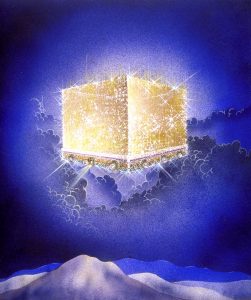 The Feast of Tabernacles points to the New Kingdom of GOD. Its capital city, the New Jerusalem, is of an incomparable glorious beauty. The LORD offers us a glimpse of it through the description made by John, who saw it. «Her light was like the most precious stone, like a jasper stone, clear as crystal. Also she had a great and high wall with twelve gates, and twelve angels at the gates, and names written on them, which are the names of the twelve tribes of the children of Israel; three gates on the east, three gates on the north, three gates on the south, and three gates on the west» (Rev. 21:2-10). These gates will honor forever the twelve Israelite tribes for their trust in GOD and obedience to His Son.
«Now the wall of the city had twelve foundations, and on them were the names of the twelve apostles of the Lamb… The city is laid out as a square; … Its length, breath, and height are equal. The foundations of the wall of the city were adorned with all kinds of precious stones…jasper… sapphire… chalcedony… emerald… sardonyx… sardius… chrysolite… beryl… topaz…chrysoprase… jacinth… amethyst. The twelve gates were pearls: each individual gate was of one pearl» (Rev. 21:11-21). These foundations will honor forever the twelve Israelite apostles who believed in Christ, the Son GOD sent to redeem us.
The throne of GOD and of His Son
John provides a glimpse of the New Kingdom of GOD and of the splendor of the New Jerusalem. He says, «the street of the city was pure gold, like transparent glass. In the middle of its street, on either side of the river, was the tree of life …the throne of God and of the Lamb shall be in it» (Rev. 22:1-3).
 Let us remember at each future Feast of Tabernacles the marvelous things GOD is preparing for His faithful worshippers. Moreover, let us always keep in mind His promise and invitation. «Rejoice with Jerusalem, and be glad with her, all you who love her; rejoice for joy with her, all you who mourn for her; that you may feed and be satisfied with the consolation of her bosom, that you may drink deeply and be satisfied with the abundance of her glory… As one whom his mother comforts, so I will comfort you; and you shall be comforted in Jerusalem» says the LORD (Isa. 66:10,11,13).
New Heavens and New Earth
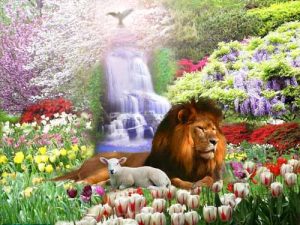 The Feast of Tabernacles revives the LORD’s most wonderful promises. Here are some. «Behold, I create new heavens and a new earth; and the former shall not be remembered or come to mind. But be glad and rejoice forever in what I create; for behold, I create Jerusalem as a rejoicing, and her people a joy. I will rejoice in Jerusalem, and in my people»…
There, «“they shall be descendants of the blessed of the LORD, and their offspring with them. It shall come to pass that before they call, I will answer; and while they are still speaking, I will hear. The wolf and the lamb shall feed together, the lion shall eat straw like the ox, and dust shall be the serpent’s food. They shall not hurt nor destroy in all My holy mountain,” says the LORD» (Isa. 65:17-19, 23-25).
The LORD shall be King over all the New Earth
Let us praise and thank our LORD, because He still allows us to have a foretaste of the inestimable joy we will experience in the future Eighth Day of the Feast of Tabernacles. And let us celebrate this last annual Sabbath, by resting from all work and rejoicing in the Lord.
 In addition, let us read and contemplate by faith the same vision that Zechariah received, when full of wonder, reported: «It shall come to pass in that day that there will be no light… It shall be one day which is known to the LORD – neither day nor night, but at evening time it shall happen that it will be light. And in that day it shall be that living waters shall flow from Jerusalem … And the LORD shall be King over all the earth…
In that day it shall be – The LORD is one, and His name is one… And all the land shall be turned into a plain… Jerusalem shall be safely inhabited… And it shall come to pass that everyone who is left of all the nations which came against Jerusalem shall go up from year to year to worship the King, the LORD of hosts, and to keep the Feast of Tabernacles. …. In that day “HOLINESS TO THE LORD” shall be engraved on the bells of horses» (Zec. 14:5-11; 16; 20).
GOD’s redemption is restoration
 The parables enacted by the seven annual feasts of GOD foretell the story of redemption. And they give evidence that GOD is accomplishing the restoration His entire creation in inverse chronological order. In fact, Christ, GOD’s appointed Restorer, started to cleanse the damages caused by sin about 2000 years ago. And He did it by beginning the purification of the last masterpiece of His original creation: man.
Our Redeemer used this inverse method for the first time with the restoration of His original creation after the universal flood. Through the flood waters He cleansed the earth from most of its uncleanness. Then, He re-established all things in the inverse order He had created them. First, He restored man (Noah and his family), who is the last of His creative masterpieces. And with him and His family, He re-established a loving relation by renewing His Eternal Covenant. After the remnant of humanity, He blessed the animals, created before man, then the plants, and then the earth. Finally, He ended His restoration activity, blessing the heavens with His rainbow of promise (Gen. 9:8-13). Whose light reminds GOD’s eternal light brightening the heavens, before the solar system was put in place (Gen. 1:1-3).
GOD’s purpose for humanity is immutable
The purpose of our Creator for the earth and all its inhabitants is immutable. Our Father who is in Heaven established all things so that His human family be happy forevermore. And so it will be.
This study on the seven annual feasts, confirms that the Almighty GOD is our eternal Provider of all that is good, through His beloved Son. This is the tragic and touching love story GOD’s seven annual feasts retell year after year. It is not surprising, therefore, that the last book of Scripture, Revelation (chapter 21,22), testifies that the end of the earth and of His human race, will be identical, or very similar, to the beginning, as reports the first book of Scripture, Genesis (chapter 1, 2).
Truly GOD’s seven annual feasts magnify His love for humanity. And they do it in a way that even little children can understand it and experience it. Let us therefore rejoice with our children, young and old, during the Feast of Tabernacles. And with them, praise GOD for the blessings that He has in store for those believe in His only Son. Those who faithfully await for Him to completely fulfill GOD’s glorious purpose for humanity, once for all.
The New Kingdom of GOD
This chart shows that at the end Christ will restore the Kingdom of GOD as it was at its beginning.
| The End | The Beginning |
| Rev. 22:4 – The redeemed see God face to face. | Gen. 3:24 – Sin prevented man to live in the presence of God. |
| Rev. 21:9 – 22:5 – The redeemed enter in the Jerusalem of God. | Gen. 3:23 – Man had to leave Eden because of his sinful condition. |
| Rev. 22:2; 2:7 – The redeemed will eat the fruits that give a perennial life. | Gen. 3:22 – Man had no longer access to the tree of life and its fruits. |
| Rev. 22:1 – The redeemed live close to the river of life. | Gen. 2:10 – Man’s first dwelling place was close to a river. |
| Rev. 22:3 – In Paradise there is no curse of sin. | Gen. 3:17 – The earth was cursed because of man’s sin. |
| Rev. 21:4 – In Paradise there is no tribulation and suffering. | Gen. 3:16 – The curse of sin introduced man’s oppression. |
| Rev. 21:4 – In Paradise there is no death. | Gen. 2:17 – Sin produced on earth death of all its living creatures. |
| Rev. 21:1 – Paradise is in the earth and heaven restored to perfection. | Gen. 1:1 – In the beginning God created the heavens and the earth. |
| Rev. 21:1 – In the new earth there is no great sea or ocean. | Gen. 1:10 – God gathered the earth’s waters in seas. |
| Rev. 21: 23 – The new earth has no need of sun because «the Lamb is its light ». | Gen. 1:15,16 – God created our solar system to give light and determine the time of seasons, days and years. |
| Rev. 21:23; 22:5 – The new earth has no need of sun and moon because it is lighted by «the glory of God». | Gen. 1:1-3 – «In the beginning…God said “Let there be light”; and there was light». |
The eternal rest with GOD
 The Eighth Day, which follows immediately the week of Feast of Tabernacles, is the seventh annual Sabbath. It is the last holy day of the cycle of God’s annual appointments. When the LORD gave instructions on the week of the Feast of Tabernacles, He said, «the first day there shall be a Sabbath-rest, and on the eighth day a Sabbath-rest» (Lev. 23:39,36; Nm 29:35).
Indeed, the sixth annual Sabbath, the first day of the Feast of Tabernacles, points to the beginning of the Millenium. And the seventh day of this feast points to the end of the Millenium and of GOD’s re-creation work. While the seventh annual Sabbath, which is the Eighth Day, foretells the beginning of the perennial rest that GOD and Christ will enjoy with saved humanity.
In that glorious Day, our Father and Jesus, will open the gate of Paradise. It will be the same gate closed because of sin. The one that was «at the east of the garden of Eden». After Adam and Eve sinned, a cherubim of GOD prevented them to go through it, using «a flaming sword which turned every way, to guard the way to the tree of life» (Gen. 3:24).
The day starting eternity
During the Eighth Day, GOD’s people left the temporary shelter of the Feast of Tabernacles and returned to their original home. This way, they started a new experience with minds reinvigorated by the Spirit of GOD. Similarly, after the earth’s Sabbatical Millennium, the saints will begin to live in the New Kingdom, the «Paradise of God» happily ever after (Rev. 2:7).
 In Scripture «The use of the number seven and eight indicates an indefinite number».[i] This points out that in the real Eighth Day, the one that will follow the real Feast of Tabernacles, this parenthesis of time characterized by sin, suffering and death, will definitively end, and we will see the sunrise of an eternal day.[ii]
Indeed, the Eighth Day, that is the seventh and last annual Sabbath, is a symbol of eternity. It reminds the first weekly Sabbath of the earth, when humanity enjoyed a perennial life conditioned by obedience. In fact, «The seventh day God ended His work which He had done, and He rested on the seventh day from all His work which He had done. Then God blessed the seventh day and sanctified it, because in it He rested from all His work which He had done» (Gen. 2:1).
After the real Eighth Day will begin, in the New Kingdom of GOD. «“it shall come to pass that, from one New Moon to another, and from one Sabbath to another, all flesh shall come to worship before Me” says the LORD» (Isa. 66:23). This is the ultimate evidence that the statement that GOD made in His covenant Law, when He declared, «It is the Sabbath of the LORD in all your dwellings» (Lev. 23:3,14,21,31,41), is unchangeable and eternal truth.
Christ will complete our salvation
The typology of the Feast of Tabernacles and its message find their fulfillment always in Jesus and in the happy ending of the project that solves all human problems. As a matter of fact, Christ is the Creator, the Redeemer and the Restorer of humanity and of GOD’s New Kingdom.
«“I am the Alpha and the Omega, the Beginning and the End” says the Lord, “who is and who was and who is to come, the Almighty”» (Rev. 1:8). Yes, Jesus Christ, together with the Father and the Spirit, has always existed. He is a divine Member of the family of our heavenly Father. And, together with Him and the Holy Spirit, He is the Creator of humanity, of the heavens and the earth (See John 1:1-4).
 More than 2000 years ago, the eternal Son of God incarnated Himself to begin the execution of the redemption project. And, after He accomplished the first fundamental act for the purification of believers, declared: «It is finished» (John 19:30, 17:4). Now, He is the Messiah that is to come again in the name of the LORD. The Savior that will liberate from the evil one His human people, His heavens, and His earth. And finally, He will be the Prince of Peace, who will sit on the right side of the Father’s throne. The Wonderful One that with triumphant voice will declare for the last time, «It is done! I am the Alpha and the Omega, the Beginning and the End» (Rev. 21:1-6).
Christ is the Rock of Ages
During their wandering in the desert, the Israelites started to suffer thirst, and fearing to perish, asked for water. In answer to their cry the LORD told Moses: «Behold, I will stand before you there on the rock in Horeb; and you shall strike the rock, and water will come out of it, that the people may drink » (Ex. 17:6).
 The rock that gave water and made the people of GOD survive in the desert represented Christ. He shed His blood and water on the cross, on the Golgotha rock (Mark 15:22). And since then He is more than willing to give the pure water sustaining a perennial life to believers. Moses understood well this truth. For this reason in His song of praise to the Almighty, he declared: «I proclaim the name of the LORD; ascribe greatness to our God. He is the Rock, His work is perfect; for all His ways are justice, a God of truth and without injustice; Righteous and upright is He» (Deut. 32:3,4).
Let us join GOD’s people at every Feast of Tabernacles and praise Christ for His wonderful works. Indeed, let each one of us believers, with sincere love and gratitude, proclaim, «You are my Father, my God and the rock of my salvation», «the rock of my refuge» forever (Ps. 89:26; 94:22).
The river of the water of life
During Jesus’ time on earth, water was one of the main features of the Feast of Tabernacles. The people prayed for the last rain. It is the one that makes the new crops grow abundantly. And they performed a particular ritual, rich in symbolism, on «the last day, that great day of the feast» of Tabernacles, the Eighth Day. The priest took a golden vase and, accompanied by many worshippers, went to the pool of Siloam to draw water. Then he returned back to the sanctuary, and poured it on the altar of burnt offerings located in the court. In the meantime, all the people played instruments and sang songs from the psalms.
Exactly, at the conclusion of this ritual, Jesus drew the attention of His people to Himself, pronouncing loudly this invitation, «If anyone thirsts, let him come to Me and drink. He who believes in Me, as the Scripture has said, out of his heart will flow rivers of living water» (John 7:37-38). For the person who searches an abundant life, there is only one Rock that can offer it today and forever. It is Jesus, the Son in whom the LORD has put His glorious Name (1 Cor. 10:5).
 In the New Jerusalem, in fact, from the Father and the Son will spring out «a pure river of water of life». From it «the tree of life» will find nourishment to bring forth «twelve fruits…every month». These the saints will eat, together with its leaves, which are «for the healing of the nations» (Rev. 22:1; see also 7:17).
How wonderful it will be to live in GOD’s New Kingdom!
[i] Seventh-day Adventist Church, Ecclesiastes, Adult Teachers Sabbath School Bible Study Guide, January-March 2007, (Silver Spring, MD: Pacific Press Pub. Asso.), p.143.
[ii]Antonino Zichichi Perché Io Credo in Colui che Ha Fatto il Mondo – “Why I believe in the One that Has Made the World” (Milan, Italy: Gruppo editoriale il Saggiatore S.p.A. 2007). This author is a major exponent of the Modern Scientific Culture, and the president of the World Federation of Scientists. For Zichichi all human discoveries have never penetrated the mysteries of the Father of Science and Mathematics, the Creator.
[iii] Ministerial Association of the General Conference of Seventh-day Adventists, Seventh-day Adventists Believe…, p. 405.